

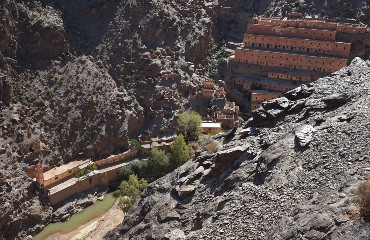
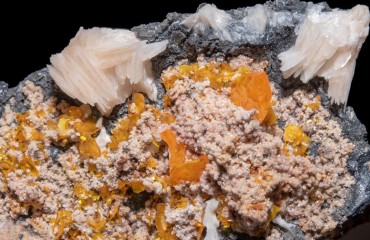
Vanadinite, Town of Ahouli, Wulfenite & Baryte Image Credits - CC Géry PARENT CC BY-SA 4.0, Drissbkd CC BY-SA 4.0, Géry PARENT CC BY-SA 4.0
Nestled in the arid hills of central Morocco, about 20 kilometres east of Midelt, lies the famous Mibladen mining area – one of the most celebrated mineral localities in the world. Known above all for its dazzling red vanadinite crystals, Mibladen has a rich history that weaves together geology, human enterprise, and the enduring allure of nature’s artistry in stone.
Laying within the High Atlas region – an area composed of folded Paleozoic sedimentary rocks intruded by younger igneous bodies – the Mibladen deposits occur mainly in dolomitic and limestone rocks that were altered by hydrothermal processes, creating a complex lead-vanadium-zinc mineralisation. These deposits are classified as hydrothermal vein and replacement types, with the oxidation zones – those sections exposed to oxygenated groundwater – being the most mineralogically rich. Over time, this weathering of the primary sulfide ores led to a wealth of striking secondary minerals such as vanadinite, wulfenite, cerussite, and pyromorphite, crystallising in vivid, colourful pockets that make Mibladen world-famous among collectors.
Mining at Mibladen began in the early 20th century under French administration, when the region’s abundant lead deposits attracted attention. The Société Minière de l’Atlas (SMA) developed extensive underground workings in the 1920s and 1930s, establishing Mibladen as one of Morocco’s most productive lead mining districts. The nearby mining town of Mibladen grew to accommodate workers, engineers, and administrators, forming the heart of what would become a bustling industrial centre.
During its peak years, the mines produced large quantities of galena (PbS) for export. Yet, as the primary ores were extracted, miners began encountering brilliant red, orange, and brown crystals coating the walls of oxidised veins – vanadinite, a vanadium-bearing lead chlorovanadate. These vivid crystals, initially regarded as waste, would soon make Mibladen famous far beyond the mining world.
By the late 20th century, as industrial mining declined, Mibladen underwent a transformation. The large-scale operations wound down, but local artisanal miners continued to explore the old tunnels, now focusing not on ore but on beautiful mineral specimens for collectors. Their work continues today, making Mibladen one of Morocco’s most important sources of world-class display minerals.
Today, the Mibladen district is home to numerous workings, the most famous being the ACF Mine (also known as the “Cretaceous Open Pit”) and the Les Dalles Mine. These sites are especially known for producing brilliant vanadinite crystals, some of which reach exceptional sizes and lustre. Other important localities include the Daoui Mine, noted for its exceptional reticulated cerussite crystals – delicate, snowflake-like formations that are masterpieces of natural geometry. Smaller prospects scattered throughout the area, often hand-dug by local miners, continue to yield specimens of remarkable beauty and variety.
Mibladen’s fame rests primarily on its vanadinite, regarded as the world’s finest. The crystals, ranging from bright scarlet to orange-red, form lustrous hexagonal prisms often perched on contrasting white baryte or grey limonite matrix. These specimens are highly sought after by collectors for their colour, perfection, and abundance of form.
Cerussite is another standout mineral from Mibladen, occurring as sharp, transparent prisms or intricate reticulated twins that sparkle under light. Wulfenite, though less common, appears as thin tabular crystals of honey-yellow to orange colour, sometimes associated with vanadinite and mimetite. Other minerals found include anglesite, pyromorphite, baryte, and galena, each adding to the region’s rich mineralogical diversity.
One of the fascinating aspects of Mibladen is the ongoing involvement of local miners who, long after industrial mining ceased, continue to work the old tunnels by hand. Using basic tools, they extract specimen-quality minerals that now travel to collectors and museums worldwide. Their expertise in identifying mineral-bearing pockets is unparalleled, making Mibladen not just a geological site but also a living tradition of artisanal mining.
The town of Mibladen, once a French mining camp, has evolved into a quiet community where mineral trading is still a way of life. Nearby, the city of Midelt serves as a major trading hub for Moroccan minerals, with dealers and collectors converging from across the globe.
From its early days as a lead-mining camp to its modern role as a source of mineral treasures, Mibladen has played a vital part in Morocco’s mineral heritage. Its vanadinites and cerussites stand out among the most beautiful mineral specimens ever found – natural works of art shaped by geological time and human persistence. Today, the Mibladen mines, with their brilliant colours and storied history, continue to remind us that even in the harsh desert landscapes of Morocco, beauty often lies just below the surface.
If you are interested in mineral specimens from Mibladen and Morocco for your collection, click HERE