
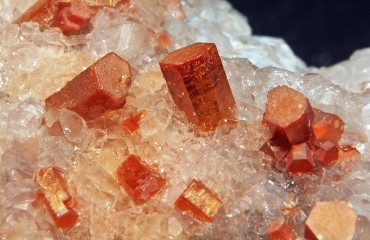
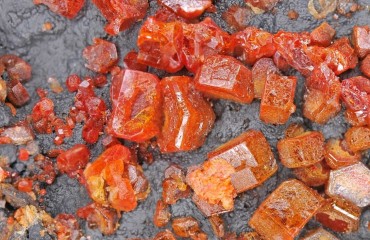

Vanadinite is one of the most visually striking minerals in the world, renowned for its brilliant red to orange hexagonal crystals and exceptional lustre. Chemically, it is a lead chlorovanadate with the formula Pb₅(VO₄)₃Cl, and it belongs to the apatite group of minerals, which also includes pyromorphite and mimetite.
Its structure consists of vanadate (VO₄) tetrahedra linked with lead and chloride ions, forming compact, symmetrical hexagonal prisms that often sparkle with a resinous to sub-adamantine shine. Crystals can appear as perfect hexagonal barrels or elongated prisms, frequently grouped in dense crusts or clusters on various matrix rocks.
In terms of physical properties, vanadinite is denser than most minerals due to its high lead content, with a specific gravity of about 6.9–7.2, noticeably heavy for its size. It has a hardness of 2.5–3 on the Mohs scale – relatively soft and easily scratched – yet its exceptional brilliance and vibrant colour make it a favourite among collectors. Its streak is pale yellow, and it is translucent to opaque depending on crystal thickness.
Vanadinite typically forms as a secondary mineral in the oxidised zones of lead ore deposits, where the mineral galena (PbS) and other lead minerals are chemically altered by oxygen-rich groundwater. It is often found together with other lead minerals like wulfenite, pyromorphite, mimetite, cerussite and anglesite. The chemistry and environmental conditions determine whether vanadinite or its close relatives form; for instance, phosphate-rich environments tend to favour pyromorphite, while arsenic-bearing conditions promote mimetite.
There are many notable colour ranges of vanadinite. The most prized are deep cherry-red crystals from Morocco, often transparent with a glassy lustre. Yellow, orange, brown, and even greyish forms occur, depending on impurities and weathering. A rarer variety known as 'endlichite' represents a vanadinite-arsenate series intermediate with mimetite, containing both vanadium and arsenic.
The world’s most famous vanadinite localities include the Mibladen and Touissit districts of Morocco, which have produced some of the finest specimens ever found – brilliant, well-formed red crystals on contrasting white or dark matrix. Other significant sources are the Apache Mine and Old Yuma Mine in Arizona, USA, and Chihuahua in Mexico, known for orange to brown crystals. Excellent examples have also come from Cordoba in Spain, Wanlockhead in Scotland, and Tsumeb, one of the most mineralogically diverse mines on Earth.
Although primarily a collector’s mineral today, vanadinite has played an industrial role as a minor ore of vanadium, a metal used to harden steel and produce rust-resistant alloys. In the early 20th century, before other sources were available, vanadinite and related minerals were a significant natural source of this strategic metal.
Two interesting facts make vanadinite especially memorable. First, despite its gem-like appearance, it can be toxic due to its lead content, so specimens should be handled carefully and never used in jewellery. Second, its fiery colour and mirror-like brilliance make it a favourite among mineral photographers – under light, the crystals almost seem to glow from within.
Vanadinite stands as a perfect fusion of chemistry and artistry: a mineral that not only played a role in metallurgy and science but continues to captivate collectors with its beauty, symmetry, and geological story.
The Assay House—Mineral Dealers of quality Mineral Specimens
Image Credits - CC Géry PARENT & Robert M. Lavinsky