


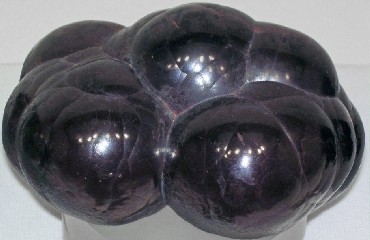
Hematite, also spelled 'haematite', is one of the most important iron ore minerals found in nature. Chemically it is iron oxide (Fe₂O₃) and occurs in a wide variety of forms ranging from massive earthy deposits to metallic, steel-grey crystals. Its name comes from the Greek word haima, meaning “blood”, a reference to the distinctive red streak it leaves when scratched across a surface. Even when hematite appears black or silver, this reddish streak is a reliable way to identify it.
The mineral crystallises in the trigonal system and is particularly famous for producing overlapping tabular crystals that form circular rosettes, known as "iron roses". It can also appear in several other habits, including botryoidal (grape-like), as massive ore, or in fibrous forms. A particularly attractive, highly lustrous, metallic form consisting of stacked parallel crystals is called specularite. The highly powdered form of the mineral mixed with clay, often deposited at the bottom of water channels, is known as ochre.
Hematite's metallic lustre, hardness, durability and variable appearance make it highly versatile, with uses in jewellery, decorative carvings, and historically as a pigment for red and brown paint. In fact, hematite was one of the earliest natural pigments, with evidence of its use in cave paintings dating back over 30,000 years.
As an ore, hematite has played a vital role in human development, supplying most of the iron used to create tools, weapons, machinery, and the foundations of the modern world. Its high density and ability to block X-rays make it useful as a material for radiation shielding, while the same high density and low cost make it ideal for use as ship ballast. In the coal industry, finely ground hematite is used to create dense solutions that help separate coal from impurities during processing.
Industrially important deposits exist in many regions of the world. In the United States, the Lake Superior district of Michigan and Minnesota once produced vast quantities during the American industrial boom. Today, Minas Gerais in Brazil is a leading source, together with South Africa's banded iron formations, which contain immense reserves. Australia's Pilbara region also hosts some of the world’s largest high-grade deposits.
From a collecting viewpoint, Cumbria in England is famous for kidney-shaped “kidney ore”. Switzerland’s alpine clefts yield the famous “iron rose” crystal rosettes, while Morocco produces fine botryoidal specimens. Spain’s Rio Tinto area also holds historic importance, with hematite mining dating back to ancient civilisations.
An interesting fact about hematite is that it is weakly magnetic in certain forms, despite being chemically distinct from magnetite. Another curiosity is its presence on Mars, where the discovery of hematite “blueberries” by NASA rovers provided key evidence for the planet’s watery past.
From ore to ornament, hematite’s role spans prehistory to space exploration, making it a mineral of both scientific and cultural significance.
The Assay House—Mineral Dealers of quality Mineral Specimens
Image Credits - CC James St. John