
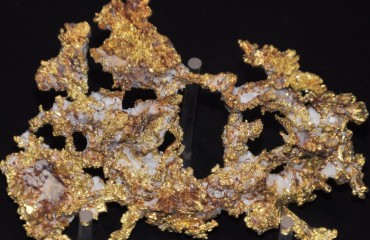


Native gold, one of the few minerals composed of a single element, has fascinated people since prehistoric times. Found in its metallic state, gold typically forms through hydrothermal processes where hot, mineral-rich fluids deposit the metal in quartz veins. Over time, erosion frees the metal, and its high density causes it to settle and accumulate in riverbeds, forming placer deposits. These alluvial concentrations have become the world’s principal sources of gold, although the mining of quartz veins in situ is also widespread.
Gold's chemical inertness, malleability, and brilliant metallic lustre make it one of the most recognisable and sought-after minerals on Earth. These properties also give the metal an almost endless range of ornamental and industrial uses. For instance, gold's scarcity and attractiveness have made its possession and display a symbol of wealth and power. Industrially, gold's electrical conductivity and chemical resistance have made it indispensable in electronic equipment, as a coating on glass to reflect heat, for targeted drug delivery, and as a chemical catalyst, to name but a few.
Gold is found in a wide range of geological environments. Some of the most famous places are the Mother Lode region of California, where the Gold Rush of the 1800s changed American history, and Kalgoorlie Super Pit in Western Australia, which is one of the largest open-pit gold mines in the world. In South Africa’s Witwatersrand Basin, vast sedimentary deposits have yielded more gold than any other region on Earth. Other significant localities include Cripple Creek, Colorado; Dahlonega, Georgia; Ontario’s Red Lake Mine in Canada; and the Ural Mountains of Russia. In Europe, Transylvania in Romania and Cornwall, Devon, and Wales in the British Isles are renowned for their small but historic gold occurrences.
The romance of gold is inseparable from the great gold rushes of the 19th century, when prospectors ventured into rugged wildernesses in search of fortune. The California Gold Rush of 1849, the Australian rushes of the 1850s in Ballarat and Bendigo, and the Klondike (Yukon) Gold Rush of 1896–1899 each sparked waves of migration, hardship, and discovery. Although the early prospectors were motivated entirely by the promise of wealth, not mineralogy, their efforts exposed countless new deposits and mineral occurrences. Many of the crystalline gold specimens they unearthed – once valued only for their bullion content – later became the prized treasures of mineral collectors and museums for their extraordinary natural beauty.
Britain’s gold story began long before these rushes. The Romans mined gold in Wales nearly 2,000 years ago, most notably at the Dolaucothi mines in Carmarthenshire. Using water channels, sluices, and primitive hydraulic techniques, they stripped away hillsides to reveal auriferous quartz veins. These operations were among the earliest gold mines in Europe, and evidence of their engineering survives today. The gold from these Welsh deposits was prized by Roman elites and may even have been used to mint coins and adorn imperial regalia.
Welsh gold remains highly coveted, particularly that from the Clogau St David’s Mine in North Wales, discovered in the 19th century. Its distinctive warm tone and historical rarity have made it world-famous. It has become a traditional choice for royal wedding rings in Britain since the early 20th century, linking the nation’s geology to its heritage. Although the Clogau mine closed in the late 20th century, exploration continues, and Welsh gold specimens are now extremely rare and valuable among collectors.
Further south, Cornwall and Devon have also produced native gold, often as fine grains and wires associated with quartz and arsenopyrite in ancient lode systems. While these occurrences never yielded the scale of production seen in Wales, they are of considerable geological interest. Streams in west Cornwall occasionally reveal tiny gold flakes, a reminder of the region’s long mining history, better known for tin and copper but equally rich in mineral diversity.
In mineral collections, native gold is most admired when it forms intricate, branching crystals, known as dendritic or arborescent forms. These delicate crystalline patterns often grow within white quartz or on a dark matrix, creating a striking contrast. Gold can also occur as filigreed wires, thin flakes, or massive nuggets. Specimens from Alaska’s Fairbanks District, Australia’s Ballarat region, and the Welsh goldfields are especially famous for their distinctive beauty and provenance.
A couple of interesting facts add to gold’s mystique. First, all the gold on Earth likely originated from ancient meteorite impacts about four billion years ago, delivering the metal from space. Second, despite its rarity in the Earth’s crust – averaging only 0.004 parts per million – it is concentrated by natural processes, allowing economic recovery from ore bodies.
Because of its enduring beauty and historical significance, native gold bridges the worlds of science, art, and commerce. Whether in the form of a collector’s specimen, a museum treasure, or a wedding ring, gold remains the ultimate symbol of rarity and enduring value – a timeless testament to the wonders of geology.
The Assay House—Mineral Dealers of quality Mineral Specimens
Image Credits - CC James St. John