
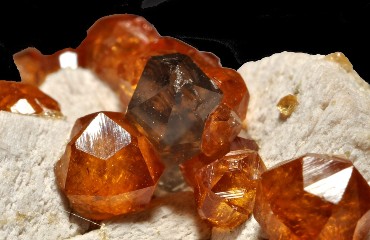
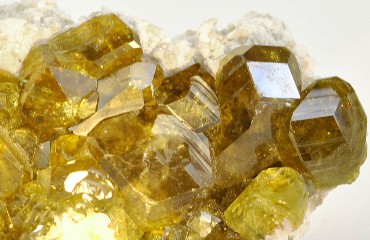

Garnets are a group of silicate minerals unified by a common crystal structure but varied in chemical composition, resulting in a huge range of colours and properties. Known since antiquity for their beauty and durability, garnets occur in metamorphic, igneous, and, less commonly, sedimentary rocks. The garnet group’s versatility and occurrence make it one of the most significant mineral families in both mineralogy and gemology.
All garnets share a common crystal structure known as the isometric (cubic) system, crystallising typically as dodecahedrons or trapezohedrons. Structurally, each garnet has a general formula of X₃Y₂(SiO₄)₃, where:
X represents divalent cations such as calcium (Ca²⁺), magnesium (Mg²⁺), iron (Fe²⁺), or manganese (Mn²⁺).
Y represents trivalent cations such as aluminium (Al³⁺), iron (Fe³⁺), or chromium (Cr³⁺).
(SiO₄) represents silicate tetrahedra forming the framework of the mineral.
The substitution of different cations in these positions gives rise to various garnet species, which fall into two main compositional series: the aluminium garnets and the calcium garnets.
The main types of aluminium garnets are:
Pyrope (Mg₃Al₂(SiO₄)₃)
Pyrope is a magnesium–aluminium garnet, typically deep red to purplish-red in colour. It is one of the most sought-after gem varieties. Pyrope forms mainly in ultramafic rocks such as peridotite and kimberlite and is a common inclusion in diamonds, since they both form in the same high-pressure, deep-earth environments within the Earth’s mantle. Classic sources include Czechia (Bohemia), South Africa, and California, USA.
Almandine (Fe₃Al₂(SiO₄)₃)
Almandine, also called almandite, is the most common garnet, rich in iron and aluminium. It exhibits deep red to reddish-brown hues. Structurally, it is similar to pyrope, but iron replaces magnesium, resulting in a higher density and a darker colour. Almandine typically occurs in metamorphic schists and gneisses, with major localities in India, Sri Lanka, Zillertal (Tyrol), and Wrangell, Alaska, USA.
Spessartine (Mn₃Al₂(SiO₄)₃)
Manganese gives spessartine its characteristic orange to reddish-orange colour. Spessartine's name is a derivative of Spessart in Bavaria, Germany, the type locality of the mineral. It forms primarily in granite pegmatites and gneisses. Gem-quality spessartine, especially the vivid 'mandarin garnet', comes from Namibia, Madagascar, and California. Violet-red spessartines are found in rhyolites in Colorado and Maine, USA.
The main types of calcium garnets are:
Grossular (Ca₃Al₂(SiO₄)₃)
Grossular, also called grossularite, is a calcium–aluminium garnet with colours ranging from colourless to green, yellow, and brown. The name 'grossular' is derived from the botanical name for the gooseberry, 'grossularia', in reference to the green garnet of this composition found in Siberia. Other shades include cinnamon brown (hessonite), red, and yellow. The green variety known as tsavorite, from Kenya and Tanzania, is highly prized. Grossular forms in metamorphosed limestones (skarns) and often contains significant inclusions of vesuvianite or diopside.
Andradite (Ca₃Fe₂(SiO₄)₃)
Rich in calcium and ferric iron, andradite displays a range of colours, including green (demantoid), yellow (topazolite), black (melanite), and colophonite, a brownish-red historical variety found on the Scandinavian islands. The black colour of melanite is caused by the partial substitution of iron by titanium. Demantoid, found in the Ural Mountains of Russia and Namibia, is one of the most expensive gemstones, especially valued for its brilliance – higher than that of diamond due to strong light dispersion. Andradite garnets typically form in skarns developed in contact metamorphosed impure limestones or calcic igneous rocks.
Uvarovite (Ca₃Cr₂(SiO₄)₃)
Uvarovite is a rare, chromium-bearing garnet, distinctly emerald green in colour. It occurs as small, bright crystals on a chromite matrix in serpentinites. Important localities include Russia’s Ural Mountains and Finland.
The almost infinite range of colours, properties, and varieties of garnets stems from the fact that these minerals form a pair of solid-solution series with each other, where one end member gradually blends with another through subtle changes in their chemical composition. Thus, pyrope (Mg), almandine (Fe), and spessartine (Mn) form the pyralspite group, where varying amounts of magnesium, iron, and manganese substitute for each other due to their ionic radii being so similar.
The other solid-solution series consists of uvarovite (Cr), grossular (Ca-Al), and andradite (Ca-Fe³⁺), where chromium, calcium, and iron similarly substitute for each other. This is known as the ugrandite group.
Both series demonstrate how slight changes in chemical composition determine a garnet’s colour, density, and refractive index, creating the many varieties found in metamorphic and igneous rocks around the world. More importantly, these variations make garnets uniquely valuable to geologists, who can determine the pressure, temperature, and composition of rocks deep within the Earth by studying the specific type of garnet formed.
Garnets are found worldwide, but several localities stand out for producing exceptional specimens. These include Bohemia in Czechia, known for its classic deep-red pyrope garnets that have been used as jewels since mediaeval times; the Ural Mountains in Russia, famous for demantoid and uvarovite crystals; Tanzania and Kenya for tsavorite and rhodolite (a mix of pyrope and almandine); Madagascar and Namibia for bright spessartine and almandine garnets; and the United States for high-quality
The Assay House—Mineral Dealers of quality Mineral Specimens
Image Credits - CC Géry PARENT & Didier Descouens