

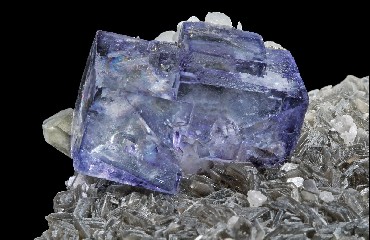
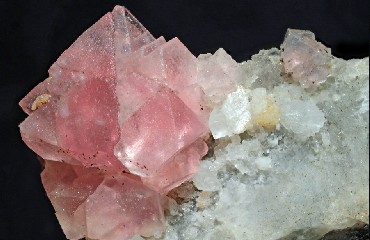
Fluorite, formerly called fluorspar, is one of the most extraordinary minerals, famous for its remarkable range of colours. Pure fluorite is colourless and transparent under both visible and ultraviolet light, but impurities and internal defects give it a dazzling array of colours. Crystals can be purple, blue, green, yellow, pink, red or even black, and many display striking zoning where several colours appear in a single crystal specimen.
The word 'fluorite' is derived from the Latin verb 'fluere', meaning 'to flow', because the mineral was historically used as a flux in iron smelting to decrease the viscosity of slag. The term 'flux' comes from the Latin adjective 'fluxus', meaning 'flowing', 'loose', or 'slack'. This use of fluorite continues today, making the mineral a vitally important industrial material.
Chemically, fluorite is calcium fluoride (CaF₂) and belongs to the halide group of minerals. It crystallises in the cubic system, forming sharp cubes and octahedra that often exhibit glassy lustre and superb transparency. Fluorite has a tendency to form twin crystals, a feature that, together with its colour variations, makes for an almost endless variety of collectible specimens. With a Mohs hardness of 4, fluorite is relatively soft and thus rarely used as a gemstone, except for demonstration pieces not intended to be worn.
One of fluorite’s most fascinating traits is that many specimens glow under ultraviolet light, a property that subsequently gave rise to the very word “fluorescence”. This effect, due to impurities like the rare-earth metals or internal crystal defects, was first studied in the 19th century and continues to intrigue both scientists and collectors. The term 'fluorescence' was first coined in 1852 to describe the effect.
In addition to its aesthetic appeal, fluorite is a vital industrial material. Apart from being used as flux in iron-making, it is also the primary source of fluorine, a gas used in the manufacture of hydrofluoric acid, refrigerants, and countless chemical products. In optics, transparent crystals, especially those from Dalnegorsk, are valued for their ability to transmit ultraviolet and infrared light with minimal distortion. The property of low dispersion has advanced its use in telescopes and other optical equipment.
Fluorite occurs worldwide, with each locality producing distinctive material. The recent Chinese mines in Hunan and Jiangxi provinces are renowned for their transparent pastel green and blue crystals, while the Illinois–Kentucky Fluorspar District in the United States has long been a classic source of large, dark purple cubes.
The Weardale district of County Durham, located in Northern England, is particularly celebrated. During the 19th and 20th centuries, mines here, such as Boltsburn, Heights, and Frazer's Hush, yielded spectacular green and purple crystals, many of which showed brilliant blue fluorescence in sunlight or ultraviolet light – specimens that remain highly prized today.
Mexico is another prolific source, with Chihuahua and Durango producing large and vividly coloured clusters. China now dominates world specimen and industrial production, with outstanding crystals from Hunan and Zhejiang provinces. Other noteworthy sources include Spain, Namibia, Morocco, and South Africa.
A highly unusual and rare type of fluorite is the massive banded variety called 'Blue John', thought to originate from the French 'bleu jaune' or 'blue yellow' on account of its unusual markings. These are thought to be caused by organic inclusions, but the evidence for this is not conclusive. Occurring only in Castleton in Derbyshire, the stone was mined extensively in the 19th century and carved for its ornamental value. The mineral is now scarce, and only limited extraction continues.
Combining beauty, science, and industrial significance, fluorite remains one of the most popular minerals with mineral collectors.
The Assay House—Mineral Dealers of quality Mineral Specimens
Image Credits - CC Géry PARENT