

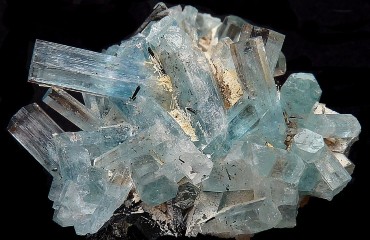

Beryl is one of the most captivating and diverse minerals known to mineralogists, collectors and gemstone enthusiasts alike. Chemically defined as beryllium aluminium cyclosilicate (Be₃Al₂Si₆O₁₈), it occurs in a vast spectrum of colours - including pink, red, green, blue, yellow, and colourless - each hue created by subtle variations in trace elements. These impurities, substituting for aluminium or other ions within the crystal lattice, produce beryl’s six principal gemstone varieties: aquamarine (blue to blue-green), bixbite (red), emerald (green), heliodor (yellow), morganite (pink to peach), and goshenite (colourless).
Beryl belongs to the hexagonal crystal system, thereby commonly forming six-sided columnar crystals, though it can also occur in massive forms. Structurally, it is a cyclosilicate, meaning its framework consists of rings of linked silicate tetrahedra (SiO₄) arranged in columns along the C-axis and layered perpendicular to it. These rings create channels running parallel to the C-axis, which can host various ions, atoms, or molecules.
The inclusion of these foreign elements disrupts the crystal’s charge balance, allowing for further chemical substitutions within the aluminium, silicon, and beryllium sites of the structure. These substitutions are what produce the wide range of beryl colours, from emerald green to aquamarine blue and golden heliodor.
Additionally, variations in the alkali content within these channel sites affect the mineral’s optical properties – increasing alkali concentrations lead to higher refractive indices and birefringence.
Beryl’s beauty is complemented by its hardness. With a Mohs hardness of 7.5–8, beryl is durable enough for jewellery, yet rare and varied enough to attract mineral collectors. Beyond its aesthetic value, beryl is the primary source of the element beryllium, a lightweight metal used in aerospace and electronics.
Beryl forms under specific geological conditions and is most commonly found in granitic pegmatites, where slow cooling allows the growth of large, well-formed crystals. It also occurs in mica schists, such as those of the Ural Mountains, and occasionally in limestone deposits, notably in Colombia. Beryl is sometimes associated with tin and tungsten ore bodies, forming in high-temperature hydrothermal veins. In pegmatites, it often occurs with quartz, feldspar, albite, muscovite, biotite, and tourmaline. The main producers of gem and industrial beryl today are Brazil, Russia, and the United States.
In its pure state, beryl is colourless and known as goshenite. Every other colour variation is the result of specific impurities in its crystal structure.
Aquamarine
The soft blue and blue-green tones of aquamarine arise from iron impurities (Fe²⁺ and Fe³⁺) within the crystal lattice. The name comes from the Latin "aqua marina", meaning "water of the sea", an apt reflection of its subtle hues. Aquamarine occurs worldwide, with fine examples from Brazil, Madagascar, Colombia, and Russia. Its hardness and clarity make it ideal for jewellery, and the pure, sky-blue variety commands the highest price.
Maxixe (Blue Beryl)
A close relative of aquamarine, maxixe beryl exhibits an intense, saturated blue colour first discovered in Minas Gerais, Brazil. However, its vibrant colour is unstable and fades upon exposure to sunlight due to the breakdown of colour centres caused by irradiation. Because of this, maxixe requires careful storage and handling and is rarely used in jewellery.
Bixbite (Red Beryl)
Bixbite is one of the world’s rarest gemstones – many times rarer than diamond. Its striking blood-red colour results from manganese (Mn³⁺) impurities. Gem-quality crystals are found in only one commercial location: the Ruby-Violet claims in the Wah Wah Mountains of Utah, USA. The Utah Geological Survey once estimated that only one red beryl crystal is found for every 150,000 gem-quality diamonds. Its extreme rarity and vivid beauty make bixbite a prized collector’s gem.
Emerald
Perhaps the most celebrated of all beryl varieties, emerald derives its green colour from chromium. Intense green beryls from Brazil, Zimbabwe, and elsewhere have also been sold and certified as emeralds, but their colour is attributed to vanadium.
The modern English word "emerald" comes via Middle English emeraude, imported from modern French via Old French ésmeraude and Medieval Latin esmaraldus, from Latin smaragdus, from Greek σμάραγδος 'smaragdos', meaning 'green gem'.
Emeralds have been treasured since antiquity, adorning royalty from Cleopatra to modern times. The finest emeralds come from Colombia’s Muzo and Chivor mines, though Zambia, Brazil, and Russia are also important producers. Exceptional forms, like the trapiche emerald, display a unique six-pointed star pattern caused by black shale inclusions radiating from a central core.
Heliodor (Golden Beryl)
Heliodor, from the Greek word for “gift of the sun”, shines in shades of golden yellow to honey orange. The colour is due to iron (Fe³⁺) within the lattice. It often shows pleochroism – changing hues when viewed from different angles – and forms in pegmatites rich in rare elements. The best specimens come from Brazil, Namibia, Ukraine, and the United States.
Morganite
Known as the “pink beryl”, morganite displays delicate shades of pink, peach, or rose, coloured by manganese (Mn²⁺) impurities. It was named after financier and gem collector J.P. Morgan, an early supporter of the American Museum of Natural History. Notable sources include Brazil, Madagascar, Mozambique, Namibia, and the U.S. Its warm hues and brilliance have made it increasingly popular in fine jewellery.
Goshenite
Colourless and transparent, goshenite represents beryl in its purest form, first discovered in Goshen, Massachusetts. While it lacks colour, its clarity and lustre make it attractive to collectors. Interestingly, goshenite can sometimes be changed into other colours, like emerald or morganite, using radiation, depending on the impurities present within.
Beryl’s appeal lies in its remarkable diversity. From the tranquil blues of aquamarine to the fiery red of bixbite and the regal green of emerald, it showcases the artistry of nature’s chemistry. Found on nearly every continent, beryl connects the worlds of mineralogy, geology, gemology, and industry, uniting science and beauty in crystalline perfection.
As both a gemstone family and a vital industrial mineral, beryl remains one of Earth’s most versatile treasures—its colours tell the story of trace elements, deep geological processes, and the enduring fascination of collectors worldwide.
The Assay House—Mineral Dealers of quality Mineral Specimens
Image Credits - CC Jamain & Robert M. Lavinsky